
Quality and design made in Germany
★★★★ 4.4 / 5 on Google
Lighting expertise since 1968
Quality and design made in Germany
★★★★ 4.4 / 5 on Google
Lighting expertise since 1968
Go to homepage

Frequently asked questions

BRUCK Info & FAQ

In our FAQs, you’ll find the most important answers about BRUCK and our luminaires.
Simply select the topic via the buttons to access all relevant information.

Customer service

Sales are handled through selected lighting retailers and electrical installers.

Under https://bruck.de/en/dealer you will find a qualified lighting retailer with a BRUCK display or an electrical installer in your area.

If you have received a damaged, defective, or incorrect item, we sincerely apologize. For processing a complaint within Germany, please contact our customer service at +49 (0)2323/5910 or send an email to sales@bruck.de.

For fast complaint processing, customer service requires the following information:

  • Receipt data (date and order number, delivery note number, invoice number)
  • Product name and item number
  • Detailed description of the issue (photos if applicable)
  • If you are an end customer and purchased your item through a lighting retailer or an electrical installer, please provide the name of the source.

Important note regarding BRUCK luminaires with glass shades:

High-quality glass products are always mouth-blown, meaning they are handmade. Small deviations in dimensions, glass thickness, metal leaf coating, or occasional air bubbles are not defects but signs of craftsmanship and make your luminaire a unique piece.

If you have purchased a BRUCK luminaire with a glass shade and notice irregularities, please read the information on BRUCK’s special handmade glass quality: Glass information

If you have received a damaged, defective, or incorrect item, we sincerely apologize. For complaint processing outside Germany, please contact the exclusive BRUCK partner listed for your country or send an email to sales@bruck.de.

For fast complaint processing, customer service requires the following information:

  • Receipt data (date and order number, delivery note number, invoice number)
  • Product name and item number
  • Detailed description of the issue (photos if applicable)
  • If you are an end customer and purchased your item through a lighting retailer or an electrical installer, please provide the name of the source.

Important note regarding BRUCK luminaires with glass shades:

High-quality glass products are always mouth-blown, meaning they are handmade. Small deviations in dimensions, glass thickness, metal leaf coating, or occasional air bubbles are not defects but signs of craftsmanship and make your luminaire a unique piece.

If you have purchased a BRUCK luminaire with a glass shade and notice irregularities, please read the information on BRUCK’s special handmade glass quality: Glass information

Please contact our customer service at +49 (0)2323/5910 or write an email to sales@bruck.de.

For quick identification of the required spare part, customer service needs the following information:

  • Exact product name and/or item number of the product that requires a spare part
  • For older products, photos are helpful

Materials

BRUCK glass lights are brilliant design elements. They give rooms a special touch. Whether dichroically coated, painted, opalized, or plated with gold and silver foil, the surfaces captivate with their unique appearance.

Quality is of utmost importance at BRUCK. All mouth-blown BRUCK glasses undergo 100% quality control regarding appearance and dimensions. Through quality control during glass production, skewed glasses, glasses with significant wall thickness variations, or scratches are sorted out. For dichroically coated glasses, additional selection is made to remove glasses with too many pinholes (uncoated points the size of a pinhead) or insufficient color play.

Furthermore, the glasses used at BRUCK have beveled and partly polished edges on the inside and outside. These edges create a clean finish. Due to handmade production, variations in glass thickness are normal and may cause uneven hanging lights. BRUCK takes specific measures to prevent this.

This ensures that BRUCK customers can fully enjoy a designer experience.

In terms of practical properties, glass is robust and resistant to temperature, environmental influences, and UV radiation, making it a very durable material.

BRUCK is committed to sustainable environmental programs. The company does not focus solely on energy-saving lamps. The entire process—from idea and production to final completion, delivery, and disposal—is guided by sustainability. BRUCK glass is produced according to RoHS (Restriction of Hazardous Substances) and REACH (Registration, Evaluation, Authorisation, and Restriction of Chemicals) environmental standards. Furthermore, BRUCK uses environmentally friendly acid baths for mattifying glass and eco-friendly water-based paints.

Glass can be produced in two ways. While high-quality products are usually handmade, i.e., mouth-blown, mass products are produced mechanically.

For manual glass production, a glassmaker needs fire, glass mass, and their breath. In this way, glass is "mouth-blown" using the rotary blowing process. The glassmaker shapes the viscous glass mass by blowing it into a mold to form the intended object. Tools such as tongs, scissors, and stamps are then used to achieve the final shape of the light.

Mechanically produced glass, so-called "pressed glass" or "tube glass," is pressed into shape through mechanical processes. At the points where the mold pieces meet, so-called "press seams" appear, identifying the object as pressed glass. Pressed glass can also have a less perfect surface, called "orange peel." BRUCK mainly uses pressed glass when high dimensional accuracy of the object's inner and outer diameter is required.

Tube glass is produced in various types of glass and different diameters (from a few millimeters to several centimeters). In most processes, a long glass tube is drawn directly from the melt and then cut into pieces. Tube glass is mainly used in laboratories or for chemical experiments because borax makes it especially heat-resistant. The advantages of tube glass are its high surface quality and precise inner and outer diameter.

Crystal Glass

BRUCK uses primarily crystal glass for its lights – a very high-quality, especially clear, colorless glass with remarkable brilliance. It differs from lower-quality glass in that it has no disturbing green tint.

Opal Glass

Opal glass appears milky-white, translucent but not transparent. BRUCK’s opal glass consists of three layers and is therefore also called triplex glass. It starts with a layer of crystal glass, followed by a layer of opalized glass, and finished with another layer of crystal glass. The first layer efficiently transmits the light from the lamp into the glass body. The middle opal layer ensures very even light diffusion, making it soft and pleasant. Due to the multiple glass layers, opal glass has high brilliance and a fascinating depth effect.

Decorated Glass

There are many ways to decorate glass. BRUCK uses glass that is mattified, coated, painted, or plated.

Mattified Glass

Mattified glass is created by acid etching or sandblasting. Acid-etched glass is produced in an elaborate chemical process in an acid bath, giving the glass a velvety-smooth surface. Acid-etched glass is mattified both inside and outside.

The surface of sand-mattified glass is roughened by sandblasting, resulting in a slightly coarser texture than acid etching. Sand-mattified glass can be mattified inside or outside, allowing shiny exterior surfaces without sacrificing the light-diffusing matt effect inside. It is always sealed with a clear lacquer on the outside for protection against dirt.

Coated Glass

Coated glass is made by applying a thin layer of metal ions or metal oxides. For dichroic coatings, layers of silicon dioxide or titanium dioxide are applied in a vacuum chamber. Up to forty layers, each only a ten-thousandth of a millimeter thick, can be vapor-deposited. Mouth-blown crystal glass of the highest quality is used as the base material.

Painted Glass

Painted glass is coated with a glossy or matte lacquer that is translucent. BRUCK glasses are coated multiple times to achieve a rich color effect. For opaque coatings, a special light-blocking lacquer is used.

Glass with Metal Leaf

Plated glass is made by hand using thin sheets of metal leaf. This metal leaf is then sealed with clear lacquer for protection. This technique creates enchanting gold or silver surfaces.

Mouth-blown glass is handmade. Each piece is therefore unique. Variations in glass thickness or small air inclusions are not defects but signs of valuable craftsmanship.

The complex coating process of glasses also presents BRUCK with demanding challenges. Achieving similar color play in dichroically coated glasses or minimizing the number of so-called "pinholes" (uncoated spots) is only possible through manual selection. At BRUCK, this is done very carefully by experienced staff. If, despite the strict selection procedures, you are not satisfied with your light, please contact BRUCK customer service by phone 02323/591-297 or email vertrieb@bruck.de. We will find a fair solution for your issue.

Varying glass thickness

Because the glass is handmade, thickness variations along the edges are not unusual. This may sometimes cause the light to hang unevenly. To prevent this, BRUCK has implemented various measures for affected products. All glass lights have the lamp head fitted with a metal tube to stabilize the body. The outer glasses of the Silva family are screwed to opal inner glasses. If the outer glass has varying thickness at the central opening, the inner glass may hang unevenly, especially if it is tightly screwed to the outer glass. Loosening the screws slightly can correct this. Additionally, the inner glass can be fine-adjusted by rotating it in steps relative to the outer glass. Queeny family glasses have a milling to ensure a precise fit of the lamp head.

Inclusions in the glass

Glass consists of 99% quartz sand, a natural raw material mostly made of quartz grains. Quartz sand always contains organic inclusions, which release gas during production due to high temperatures, creating small air bubbles in the glass. Air inclusions can also occur when the glassmaker pierces the glass mass with the blowpipe, introducing oxygen that remains partially in the glass.

Color variations in dichroic coating

Dichroic coating is applied as an extremely thin layer, only a few ten-thousandths of a millimeter thick. Even minor deviations can cause different color play. Glasses with similar color effects can therefore only be grouped through manual selection. BRUCK offers a free selection service for assembling dichroic glasses with similar color play.

Pinholes in coated glass

During coating, so-called pinholes can occur, about the size of a pinhead. These uncoated points are unavoidable due to the delicate production process. Glasses with many pinholes are removed by BRUCK.

Cantara Glass Gold

  • Mouth-blown crystal cylinder inside for even and soft light distribution
  • Beveled and polished edges for a clean finish without glass thickening
  • Patented glass suspension, invisible from the outside
  • Glass interior coated black or white and covered with gold or silver foil to create a sensually warm or brilliantly cool light in the room
  • Protected with a clear coating

Silva Dicro

  • Mouth-blown crystal glass of the highest quality with minimal tolerances
  • Beveled and polished edges for a clean finish without glass thickening
  • Residues (grease, etc.) are removed from the glass before dichroic coating by repeated washing and drying
  • Up to 40 dichroic metal oxide layers applied to achieve the unique Dicro effect
  • Glass reflector inside for even and soft light distribution

Mattified, dichroically coated, painted glasses, crystal glass

Mattified, dichroically coated, painted glasses, and crystal glasses can be carefully cleaned with a damp, smooth, lint-free cloth. Do not use hard or abrasive objects. Dishwasher cleaning is not recommended.

Glasses coated with metal leaf

Glasses coated with gold or silver leaf can be carefully cleaned with a damp, smooth, lint-free cloth. Do not use hard or abrasive objects. Dishwasher cleaning is not recommended.

Safety

Bathrooms require higher safety standards than other living spaces. Lights installed in certain areas of a bathroom must also be rated for wet locations, meaning they need to be well protected against water and moisture. The specific protection level provides this information. The letters IP are always used, followed by two digits. These digits indicate the level of protection the light offers against foreign objects (1st digit) and moisture (2nd digit).

1st Digit 2nd Digit
0 – unprotected unprotected
1 – protected against solid objects > 50 mm protected against dripping water
2 – protected against solid objects > 12 mm protected against dripping water at an angle < 15°
3 – protected against solid objects > 2.5 mm protected against spraying water
4 – protected against solid objects > 1 mm protected against splashing water
5 – dust-protected protected against water jets
6 – dust-tight protected against powerful water jets
7 – / protected against temporary immersion
8 – / protected against continuous immersion

Luminaires

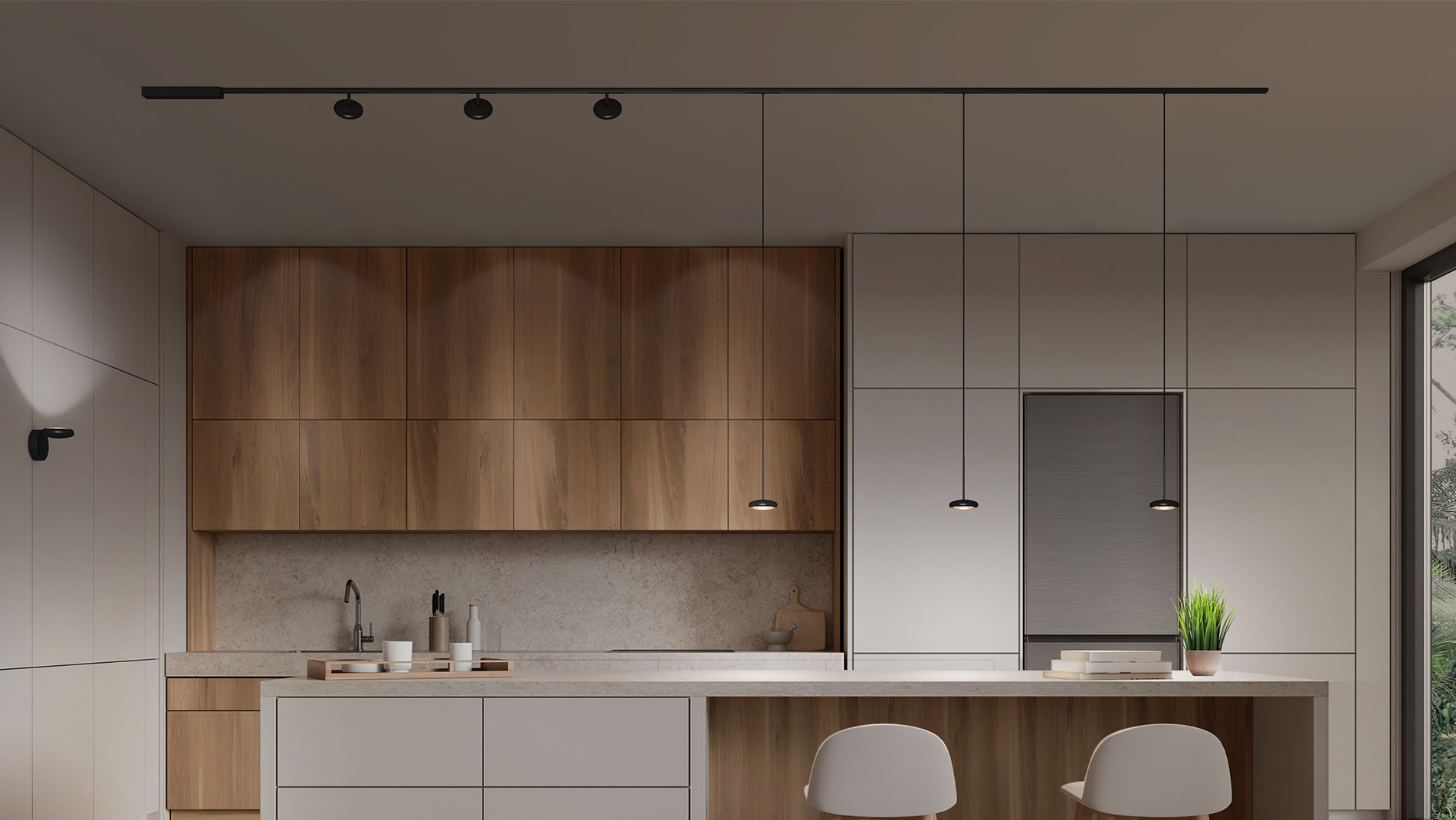
Track systems

The High-Line system from Bruck is usually supplied with inductive transformers. If you purchase LED retrofit lamps directly from Bruck, we guarantee trouble-free operation of the system. If you buy the LED retrofit lamps yourself, please ensure that the retrofit lamps are also suitable for inductive loads. The retrofit lamps are then marked with an "L". Also pay attention to the specifications of the retrofit lamp manufacturer regarding power!

The LED power is not always equivalent to the power to be considered for the transformer!

You can find all the details on our page about track systems.

Control gear

Toroidal Transformers

Toroidal transformers are the most efficient magnetic transformers. Depending on the quality of the copper wire, the efficiency is between 75–85%. Due to their closed, air-gap-free toroidal design, no-load losses are significantly lower than those of EI-core transformers. Toroidal transformers are suitable for applications where low standby losses are important. By oversizing the transformer, losses under load can also be reduced: at 50% partial load, losses are only ¼ of those at full load.

BRUCK toroidal transformers feature short-circuit protection via a fuse, as well as overload and overtemperature protection. A current monitor according to VdS / ENEC can optionally be connected. With BRUCK toroidal transformers, you can be on the safe side.

EI-Core Transformers

EI-core transformers, also called "block transformers", have primary and secondary windings wound separately next to each other on the core. Due to the longer magnetic path through air, losses are higher than with toroidal transformers. Efficiency ranges from 70–80%. BRUCK EI-core transformers have short-circuit protection via a fuse, as well as overload and overtemperature protection. A current monitor according to VdS / ENEC can optionally be connected. With BRUCK EI-core transformers, you are on the safe side.

Electronic Transformers with AC Secondary Output

Electronic transformers (AC) are very compact. Their small size makes them ideal for use in luminaires or for ceiling/wall installation. The primary voltage is converted to secondary voltage via a combination of small coils and electronic components, allowing high efficiency of 95–98%. The AC secondary voltage operates at 40–50 kHz, which usually limits the secondary cable length to around 2 meters. Please also refer to the manufacturer’s individual specifications.

BRUCK AC electronic transformers provide maximum safety and convenience with short-circuit, overload, and overtemperature protection. After a fault is corrected, they immediately return to full functionality. Soft start increases lamp life and reduces maintenance costs.

Electronic transformers require a minimum load of around 20%. If the minimum load is not reached, connected lamps may not light or may flicker. The transformer may also hum.

Electronic Transformers with DC Secondary Output

Electronic DC transformers differ from AC transformers mainly in having a rectified secondary voltage. This allows longer low-voltage systems to be powered. Depending on the transformer type, 6–20 meters of secondary cable are possible, allowing installation out of sight. DC transformers have an efficiency of 90–95%.

The minimum load of around 20% is also required, as with AC electronic transformers. If the minimum load is not reached, connected lamps will not light or may flicker, and the transformer may hum.

BRUCK DC electronic transformers provide maximum safety and convenience with short-circuit, overload, and overtemperature protection. After a fault, they immediately return to full functionality by switching the mains power off and on. Soft start increases lamp life and reduces maintenance costs.

Dimming a halogen or incandescent lamp can significantly increase its lifespan and reduce energy consumption. Brightness decreases more than energy use when dimmed, which reduces energy efficiency. Frequently operating a lamp in dimmed mode can save energy by using a lower-wattage lamp. Dimming also changes the light color, increasing the red component.

Connecting Magnetic Transformers

When switching on magnetic transformers, the higher inrush current can trip the upstream circuit breaker. Inrush current can be up to ten times the nominal current. For example, a 300 VA transformer with 1.3 A nominal current may briefly draw up to 13 A. Using a 16 A circuit breaker can cause unwanted trips. Inrush current limiters prevent this. BRUCK magnetic transformers of 300 and 400 VA are equipped with inrush current limiters as standard, allowing multiple transformers to be connected.

Connecting Electronic Transformers

Multiple electronic transformers can be switched together with one switch without issues, as their inrush currents are low. Please note the switch’s rated load. High inrush spikes, as with magnetic transformers without inrush limiters, do not occur with BRUCK electronic transformers.

Electronic transformers must not be connected together on the secondary side.

Transformers usually consist of two coils wound around an iron core. The core is made of thin, insulated sheets. Humming occurs when magnetic forces cause the sheets to vibrate.

Electronic transformers work on a different principle and therefore do not hum. Here you can find solutions for silent operation of transformers.

Lighting knowledge & light sources

The EU has decided to phase out incandescent bulbs because they are considered "environmental offenders" due to their poor energy efficiency. Another disadvantage of traditional incandescent bulbs is their relatively short lifespan of only about 1,000 hours. Only five percent of the energy used is converted into light; the rest is emitted as heat.

The phase-out of incandescent technology was completed in 2012, as all incandescent bulbs now needed to meet energy efficiency class C. However, no conventional incandescent bulb meets this requirement.

There are three alternatives to incandescent bulbs: halogen lamps, LED lamps, and energy-saving lamps. Halogen lamps with energy efficiency class B and C are initially allowed to remain on the market.

For atmospheric, brilliant light, 12V or 230V Eco halogen lamps are recommended. They save up to 50% or 30% energy compared to conventional incandescent bulbs, without compromising light quality.

LED lighting is considered the future of household lighting. It is a serious alternative to incandescent, halogen, and energy-saving lamps. LEDs are particularly valued for their long lifespan of up to 25,000 hours, low maintenance, and absence of mercury. Consumers increasingly appreciate LEDs’ energy-saving potential of up to 80% compared to conventional bulbs. Furthermore, warm-white LEDs can offer excellent color rendering with an index of up to Ra=95. They do not flicker and are immediately at 100% brightness when switched on, unlike energy-saving lamps.

Energy-saving lamps reduce energy consumption and provide strong light output. They consume about 80% less electricity than incandescent bulbs and have a lifespan of 6,000 hours—six times longer. Due to their design, these lamps are always frosted, distributing light evenly without harsh shadows, but the color rendering index of Ra=80 makes colors appear less vibrant. For particularly brilliant light, halogen or high-quality LED lamps are the better choice.

When buying incandescent bulbs, it was enough to check the packaging for shape and wattage. To replace an incandescent bulb with another type of lamp with the same brightness, you need to pay attention to the luminous output measured in lumens. Also important are color temperature (warm/cool) and a similar color rendering index (Ra or CRI).

Example: To replace a 60W incandescent bulb with 710 lumens (about 12 lumens per watt), the following lamps are suitable:

  • LED lamps: 470 lumens (= 8 W), 806 lumens (= 12 W)
  • Halogen lamps: 630 lumens (= 42 W), 840 lumens (= 53 W)
  • Energy-saving lamps: 630 lumens (= 11 W), 850 lumens (= 15 W)

If you want to dim LED retrofit lamps, please consider some important points. Here you can find tips for dimming LED retrofit lamps and LED luminaires.

LED stands for "Light Emitting Diode." LED retrofit lamps are an efficient replacement for incandescent, halogen, and energy-saving lamps. They come with screw, plug, or bayonet bases and can be easily used in existing fixtures.

With screw bases and classic bulb shapes, they replace conventional incandescent, halogen, and energy-saving lamps; with plug or bayonet bases, they replace halogen lamps.

LED technology is considered the future of household lighting. Here are the main advantages of LED at a glance:

  • Significant energy savings: currently up to 80% compared to incandescent bulbs, and expected to increase.
  • Extremely long lifespan: approximately 25,000 hours and about 12,500 switching cycles.
  • Perfect light quality: warm-white LEDs have excellent color rendering up to Ra=95, no flicker, and are immediately 100% bright when switched on.
  • Environmentally friendly: reduced CO² emissions and no mercury in LED lamps.

The idea that LED emits cold white light is a misconception from the early days of LED technology. Today, LEDs are available in various color temperatures, indicated in Kelvin. The white LED spectrum ranges from 2,700K (warm white) to 6,000K (cool white).

Yes, if you follow these guidelines:

First, make sure the LED lamp is dimmable. The dimmability of products should always be clearly indicated on the packaging.

Dimming LED retrofit lamps for 230V:

The simplest way is to use LED lamps that operate directly on mains voltage (E27, E14, GU10), as no transformer is needed. A potential challenge for 230V LED lamps can be the dimmer's minimum load requirement, since LED lamps consume very little power. Many dimmers only start working at 40W or more, while modern dimmers can work from 20W. Ensure that the connected lamps meet the necessary minimum load.

Additionally, the correct type of dimmer must be selected (leading-edge or trailing-edge). This information is on the packaging, in the manual, or on the manufacturer’s website. Modern LED-compatible dimmers with the necessary minimum load and three-wire connection including neutral are recommended. Dimming LEDs with phase dimmers may reduce efficiency and the brightness can only be dimmed down to 10–20% of full output.

Dimming LED retrofit lamps for 12V:

12V LED retrofit lamps are available in dimmable and non-dimmable versions. The dimmable type is designed for leading-edge or trailing-edge dimming. The lamp must match the existing driver; otherwise, the driver must be replaced. The type of dimming required is indicated on the packaging. Modern LED-compatible dimmers with three-wire connection including neutral are recommended. Dimming with phase dimmers may reduce efficiency and can only dim down to 10–20% of full brightness.

In rare cases, problems may occur with some conventional dimmers even if the correct dimming type is used. In such cases, contact the lamp manufacturer.

Due to current limitations in dimming 12V LED retrofit lamps, Bruck recommends not dimming these lamps.

Dimming LED luminaires:

Integrated LED luminaires can also be dimmed depending on the driver used. Refer to the user manual for details.

Professional dimmers are recommended for LED luminaires, integrated in the luminaire rather than the switch box. Dimming is controlled via wireless push-buttons or dimmers sending control signals through the mains to the luminaire. Bruck plans to introduce such luminaires in 2013/2014.

  • How do I assess the quality of LED retrofit lamps?
  • What does Bruck’s "tested quality" mean for LED lamps?

Bruck offers tested LED lamps from renowned manufacturers as replacements for 230V halogen lamps, suitable for Bruck luminaires. Depending on the model, these lamps are dimmable or non-dimmable.

Tested LED lamps from renowned manufacturers are also available as replacements for 12V halogen lamps, suitable for Bruck luminaires and Bruck transformers in non-dim operation.

Lux measures illuminance. It indicates the ratio of incident luminous flux to the illuminated area (lumens per square meter). This helps determine whether a surface, like a desk, is sufficiently lit.

For example, a sunny summer day produces about 100,000 lux. Lighting a computer workstation requires around 500 lux.

Kelvin (K) indicates the color temperature of a lamp. Common lamps range from 3,300K (warm white) to 5,300K (cool white).

Color temperature is determined by comparing the light with a "blackbody radiator," which shows colors from dark red to light blue as it heats. The temperature at which the lamp matches the blackbody color is its color temperature.

The wattage of a lamp indicates its energy consumption. How much of this energy is converted to light depends on the lamp's efficiency.

  • LED retrofit lamps (2012 status): approx. 60 lumens/Watt
  • 230V Eco halogen lamps: approx. 16 lumens/Watt
  • 12V Eco halogen lamps: approx. 25 lumens/Watt
  • Energy-saving lamps: approx. 55 lumens/Watt

Lumen (lm) measures the luminous flux of a lamp. The higher the lumen value, the more light the lamp emits.

Dimmer recommendations

Bruck LED lights can always be dimmed using a phase dimmer, such as the traditional wall-mounted type. To ensure it works properly, please note:

  • Only a few specific dimmer models are truly optimal. Please use one of the dimmers listed below.
  • Adjust after installation! High-quality dimmers offer various settings. These must be used. Then it works reliably.

Adjusting the Dimmer

Automatic mode:
Many dimmers have automatic load detection, switching by themselves between leading-edge or trailing-edge. Please disable this feature. Instead, set it permanently to trailing-edge.

Minimum load:
Lights may flicker when dimmed very low. You can set a threshold. Adjust the minimum load high enough to prevent flickering.

Neutral wire:
Some dimmers allow connecting a neutral wire. If available, it must be used.

Minimum dimmer power:
LEDs are energy-efficient, but dimmers require a minimum load to function properly.

Set maximum load:
Reduce it if flickering occurs at maximum load.


Our Recommendations

Recommendation - Rotary Dimmer
Vadsbo VD300

Recommendation - Flush-mounted Dimmer (for installation behind a switch controlling the dimmer)
For dimming via a connected switch and/or Casambi.
LD220WCM Vadsbo

Compensation Module
This helps eliminate flickering when dimming. It is connected in parallel to the light. This can be done (where possible) inside the luminaire, in the canopy, or behind the wall switch/dimmer.
We recommend the Gira Module 237500.

Find a BRUCK specialist retailer near you

and experience our high-quality lighting solutions live.

Find retailer now